


India, Mapped in Cocoa
Chocolate in India is no longer just an imported indulgence — it is becoming a story of origin.
In 2026, Indian cacao is stepping into global conversations not as a curiosity, but as a terroir with identity. What once began as an experimental crop interwoven with coconut and areca plantations has matured into a quietly confident ecosystem of farmers, fermenters and craft chocolate makers shaping a distinctly Indian flavour language.
The Indian cacao map is not vast in scale compared to Latin America or West Africa, but what it lacks in geographic sprawl, it compensates for in nuance. Each growing pocket — Kerala’s humid belts, Tamil Nadu’s structured estates, Karnataka’s mixed-crop farms, Andhra Pradesh’s emerging clusters — produces cacao shaped by monsoon rhythms, soil diversity and intercropping traditions unique to the region.
And increasingly, these differences are being tasted.
Terroir shaped by monsoon and soil
Indian cacao grows in conditions that are fundamentally different from the equatorial monoculture plantations typically associated with global cocoa production. Much of India’s cacao is cultivated under shade, sharing space with coconut, banana, pepper and nutmeg. This agroforestry model moderates sunlight, retains soil moisture and creates microclimates that influence bean development.
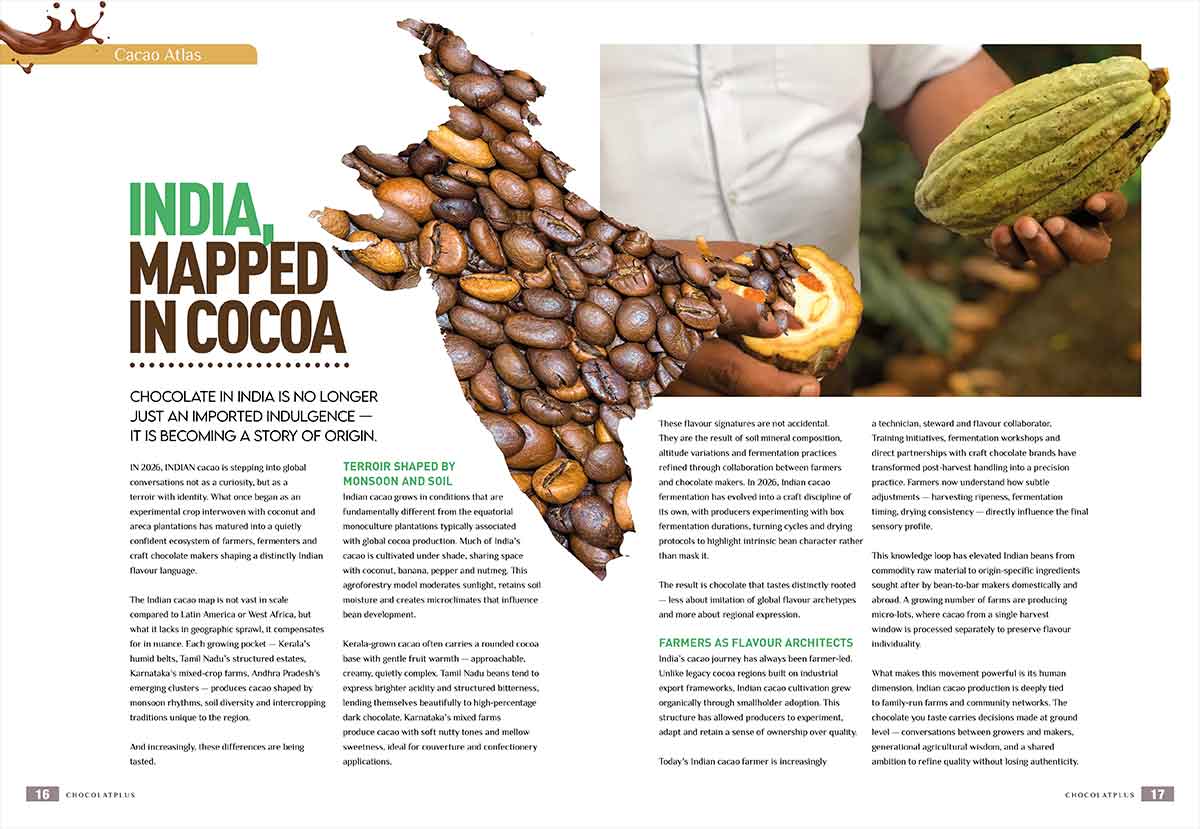
Kerala-grown cacao often carries a rounded cocoa base with gentle fruit warmth — approachable, creamy, quietly complex. Tamil Nadu beans tend to express brighter acidity and structured bitterness, lending themselves beautifully to high-percentage dark chocolate. Karnataka’s mixed farms produce cacao with soft nutty tones and mellow sweetness, ideal for couverture and confectionery applications.
These flavour signatures are not accidental. They are the result of soil mineral composition, altitude variations and fermentation practices refined through collaboration between farmers and chocolate makers. In 2026, Indian cacao fermentation has evolved into a craft discipline of its own, with producers experimenting with box fermentation durations, turning cycles and drying protocols to highlight intrinsic bean character rather than mask it.
The result is chocolate that tastes distinctly rooted — less about imitation of global flavour archetypes and more about regional expression.
Farmers as flavour architects
India’s cacao journey has always been farmer-led. Unlike legacy cocoa regions built on industrial export frameworks, Indian cacao cultivation grew organically through smallholder adoption. This structure has allowed producers to experiment, adapt and retain a sense of ownership over quality.
Today’s Indian cacao farmer is increasingly a technician, steward and flavour collaborator. Training initiatives, fermentation workshops and direct partnerships with craft chocolate brands have transformed post-harvest handling into a precision practice. Farmers now understand how subtle adjustments — harvesting ripeness, fermentation timing, drying consistency — directly influence the final sensory profile.
This knowledge loop has elevated Indian beans from commodity raw material to origin-specific ingredients sought after by bean-to-bar makers domestically and abroad. A growing number of farms are producing micro-lots, where cacao from a single harvest window is processed separately to preserve flavour individuality.
What makes this movement powerful is its human dimension. Indian cacao production is deeply tied to family-run farms and community networks. The chocolate you taste carries decisions made at ground level — conversations between growers and makers, generational agricultural wisdom, and a shared ambition to refine quality without losing authenticity.
Craft chocolate and a new identity
India’s craft chocolate movement has accelerated dramatically over the past decade, but 2026 marks a turning point: origin is no longer an afterthought — it is the headline.
Bean-to-bar makers are now building collections around specific Indian regions, celebrating fermentation styles and harvest seasons the way wine producers honour vintages. Tasting flights featuring Tamil Nadu versus Kerala cacao are becoming educational rituals in boutique chocolate studios and tasting rooms.
This focus is reshaping consumer perception. Indian chocolate is no longer defined solely by sweetness or confectionery nostalgia. Instead, it is entering the realm of sensory appreciation — acidity, tannin structure, aromatic complexity — encouraging drinkers to approach chocolate with curiosity rather than habit.
Chefs are responding in kind. Indian-origin cacao is appearing in plated desserts that highlight its terroir: Kerala cacao paired with coconut textures, Tamil Nadu dark chocolate balanced with spice infusions, and Karnataka beans integrated into nut-forward compositions. Chocolate is becoming a bridge between agricultural identity and contemporary gastronomy.
Sustainability as flavour preservation
India’s cacao ecosystem naturally aligns with regenerative agriculture principles. Shade-grown intercropping promotes biodiversity, improves soil health and reduces environmental stress. Many cacao farms operate within polyculture systems that mirror forest conditions — an approach increasingly recognized as essential for climate resilience.
As climate variability reshapes global cacao production, India’s adaptive farming models are gaining attention. The emphasis is shifting from yield maximization to flavour longevity — protecting heirloom cacao genetics, refining soil management and investing in farmer education.
Transparency initiatives are also strengthening the connection between origin and consumer. Traceable sourcing models allow chocolate makers to document farm partnerships, harvest conditions and fermentation processes, turning each bar into a narrative of place and stewardship.
A country discovering its cacao voice Indian cacao is still young in the global context — and that is precisely its strength. It is not burdened by rigid tradition or industrial expectation. Instead, it is evolving through experimentation, collaboration and an openness to redefine what origin-driven chocolate can mean.
The Cacao Atlas sees India not as an emerging footnote, but as a landscape actively writing its flavour identity. Every harvest deepens understanding. Every fermentation refines expression. Every bar becomes a conversation between land and craft.
To taste Indian cacao today is to witness a country mapping itself through chocolate — monsoon to mouth, soil to story.
And in that journey lies a simple truth: Origin is no longer where chocolate comes from. It is who chocolate is becoming.

