
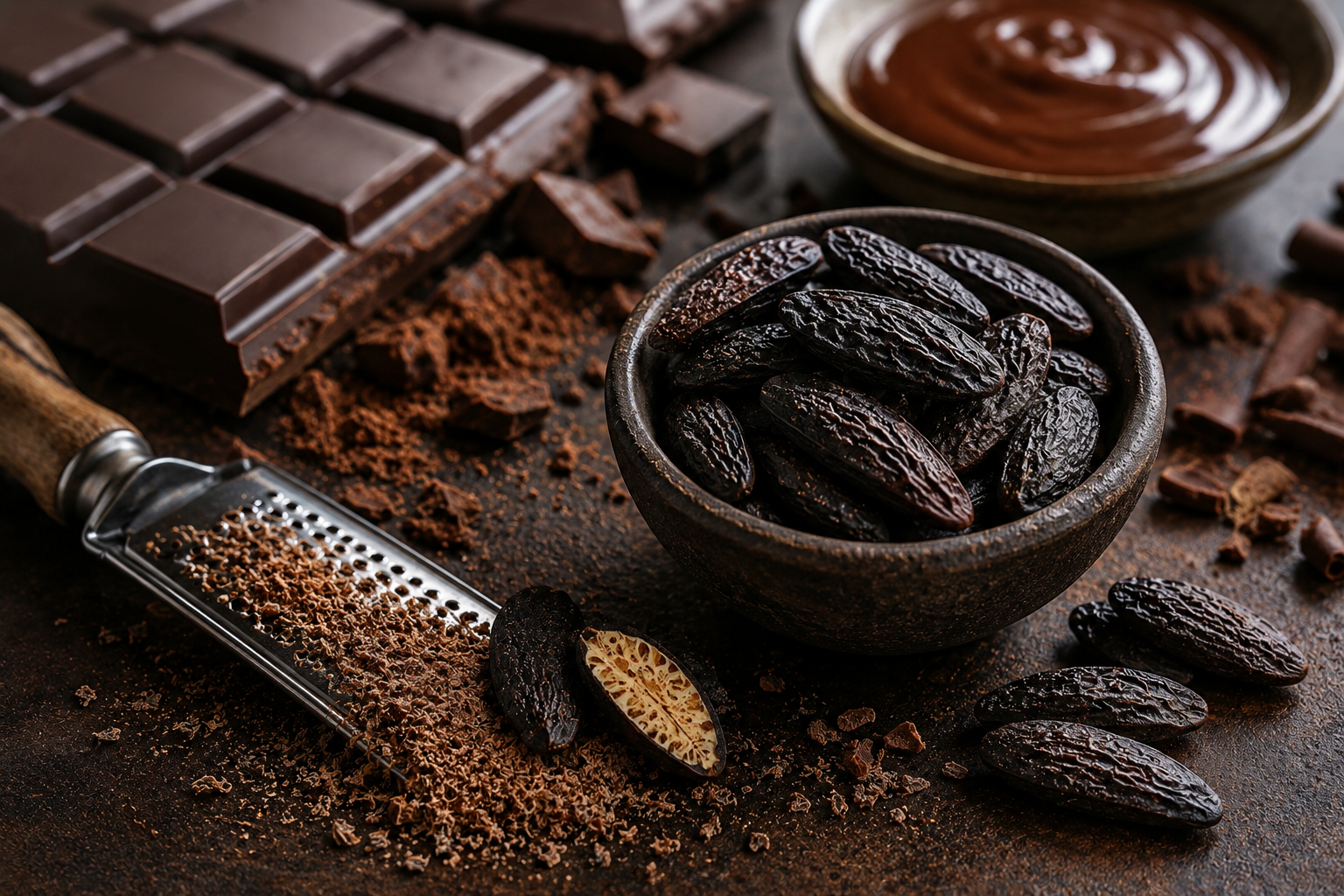
Chocolate and vanilla have shared the spotlight for centuries. Coffee, hazelnuts and caramel are equally familiar companions. Yet tucked away in the spice drawers of some of the world’s finest pastry kitchens is an ingredient that rarely appears on a menu, despite its extraordinary ability to transform chocolate.
Meet the tonka bean.
Dark, wrinkled and no larger than an almond, the tonka bean comes from the fruit of the Dipteryx odorata tree, native to the tropical forests of South America. For generations, it has been used in perfumery for its rich fragrance, but over the past two decades it has also earned a devoted following among pastry chefs and chocolatiers.
Its appeal lies in complexity. A single grated bean releases aromas that evoke vanilla, roasted almonds, cinnamon, cloves and freshly cut hay, creating a flavour profile that is difficult to replicate with any other ingredient.
Used with restraint, it doesn’t dominate a dessert. Instead, it quietly enhances the chocolate, making familiar flavours feel deeper and more rounded.
From the Amazon to the Pastry Kitchen
Tonka beans are primarily harvested in Venezuela, Brazil and Guyana, where the towering Dipteryx odorata tree thrives in humid tropical forests. After the fruit ripens and falls naturally, the seeds are removed, dried and carefully cured for several months.
During curing, a white crystalline coating gradually forms on the surface of the bean. This is coumarin, the natural aromatic compound responsible for the ingredient’s unmistakable fragrance.
The curing process is as important as it is for vanilla.
Without patience, the aroma never fully develops.
Once ready, the beans are incredibly potent. One bean can flavour several desserts, which is why professional kitchens usually grate only a small amount using a microplane.
Why Chocolate Loves Tonka Bean
Chocolate already contains hundreds of naturally occurring aromatic compounds. Tonka bean complements many of them rather than competing against them.
Dark chocolate develops warmer, almost caramel-like notes.
Milk chocolate gains extra depth without becoming overly sweet.
White chocolate acquires subtle spice and floral aromas that balance its creamy richness.
For this reason, tonka bean is often paired with chocolate mousses, ganaches, crémeux, ice creams and whipped creams rather than being used as a dominant flavour.
Its role is similar to seasoning in savoury cooking.
When used well, diners notice the improvement without immediately identifying the ingredient.
A Favourite Among Pastry Chefs
Many of the world’s leading pastry chefs keep tonka bean close at hand.
Pierre Hermé has long explored its relationship with chocolate and fruit, while chefs including Cédric Grolet, Jordi Roca and Janice Wong have incorporated tonka into desserts where aroma plays as important a role as sweetness.
Its versatility makes it equally comfortable alongside pears, cherries, apricots, coffee, hazelnuts and citrus.
For chocolatiers, it offers an opportunity to create flavour profiles that feel familiar yet unexpected.
A simple dark chocolate ganache infused with freshly grated tonka can deliver remarkable complexity without introducing additional sweetness or acidity.
Using Tonka Bean in Chocolate
Professional chefs generally use tonka sparingly.
The bean can be finely grated directly into warm cream before preparing a ganache, infused into milk for custards and ice creams, or incorporated into chocolate mousse where its aroma develops gradually as the dessert rests.
Because the flavour intensifies over time, many chefs prepare tonka-based components a day before serving.
This allows the chocolate and spice notes to marry naturally rather than competing for attention.
A little truly goes a long way.
Chef’s Pairing Guide
Tonka bean works particularly well with:
- Dark chocolate (64–75%)
- Milk chocolate
- Coffee
- Vanilla
- Hazelnut
- Almond
- Pear
- Cherry
- Fig
- Orange
- Caramel
Avoid pairing it with strongly spiced desserts, where its delicate fragrance can easily be lost.
A Word of Caution
Tonka bean naturally contains coumarin, a compound that contributes to its distinctive aroma. While it is used in very small quantities by professional chefs, regulations regarding its use vary across different countries and markets. Businesses developing commercial products should always refer to the applicable food regulations in their target markets before incorporating tonka bean into recipes.
For restaurant kitchens, however, its restrained use has made it a valued ingredient among pastry professionals seeking subtle aromatic complexity.
Why It Deserves the Spotlight
Chocolate is often celebrated for its own remarkable flavour, yet the right supporting ingredient can reveal dimensions that might otherwise remain hidden.
Tonka bean doesn’t seek attention. It doesn’t overpower.
Instead, it quietly enhances what is already there, adding warmth, elegance and depth to every bite.
Perhaps that’s why so many pastry chefs consider it one of their most treasured ingredients. Not because it’s rare.
But because, when used with care, it reminds us that sometimes the smallest ingredients leave the biggest impression.


Add Comment