
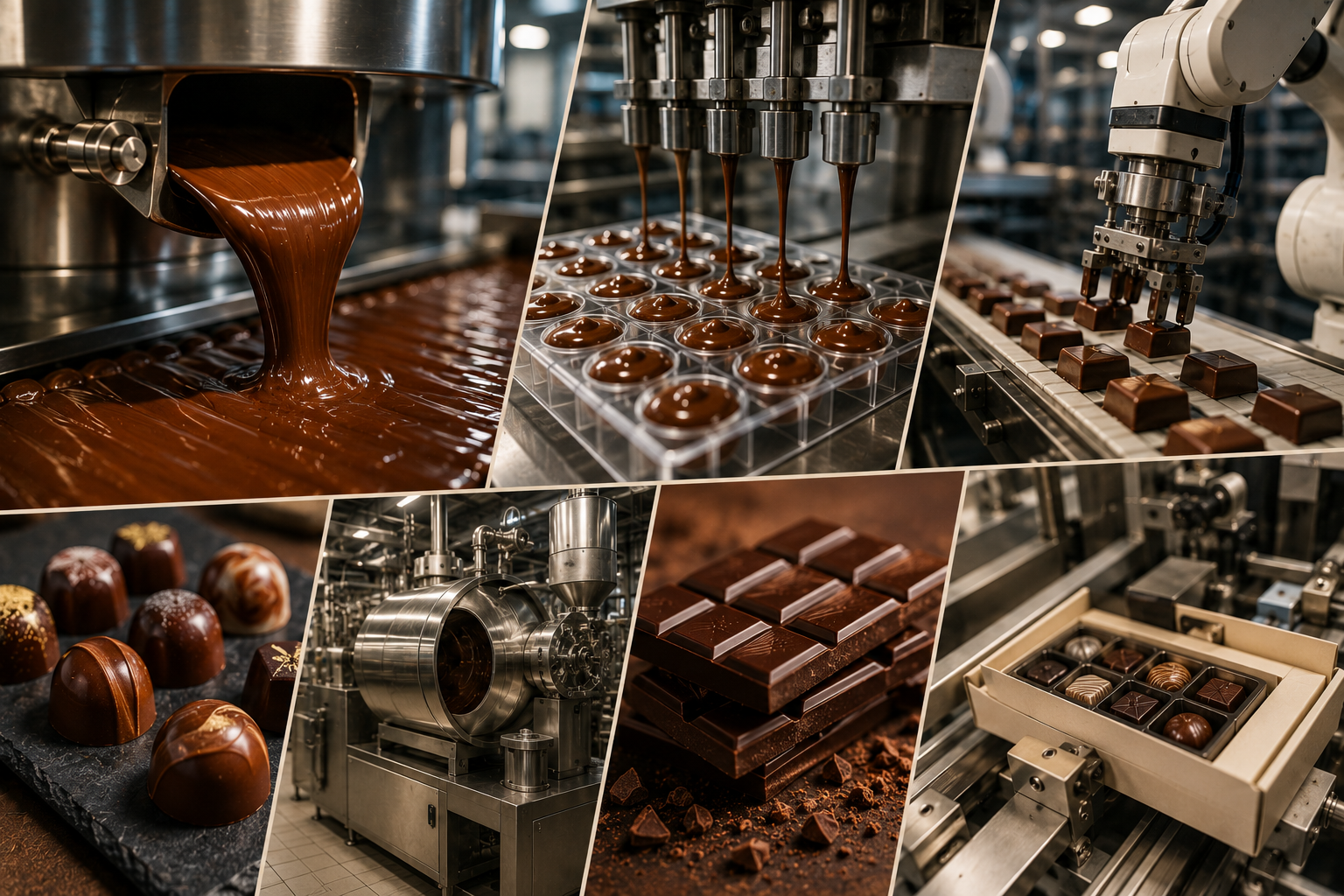
Walk into a modern chocolate production facility in 2026, and the aroma of freshly tempered chocolate is accompanied by something equally remarkable—the quiet precision of automation, digital monitoring and intelligent machinery working in perfect harmony. While craftsmanship remains at the heart of premium chocolate, the equipment behind the scenes has evolved dramatically.
Today’s manufacturers are expected to deliver exceptional consistency, minimise waste, optimise energy consumption and maintain impeccable food safety standards, all while responding to increasingly complex consumer demands. Whether producing handcrafted bonbons in small batches or manufacturing thousands of chocolate bars every hour, technology has become indispensable.
From artisan workshops to industrial production lines, the tools shaping the future of chocolate are not replacing skilled chocolatiers—they are empowering them.
Tempering: The Science Behind Every Perfect Chocolate
Few processes are as critical to chocolate making as tempering.
Proper tempering ensures chocolate develops a stable crystal structure, giving it its glossy finish, satisfying snap and smooth mouthfeel. Poorly tempered chocolate, by contrast, appears dull, soft and prone to fat bloom.
Modern tempering machines have transformed this once labour-intensive process.
Today’s equipment offers precise temperature control, continuous monitoring and programmable recipes that ensure consistency across production batches. Advanced continuous tempering systems allow manufacturers to maintain uninterrupted production while significantly reducing manual intervention.
Many premium manufacturers now integrate tempering systems directly with depositing and enrobing lines, creating seamless production workflows that improve both efficiency and product quality.
For artisan chocolatiers, compact tabletop tempering machines have become increasingly sophisticated, enabling small businesses to achieve professional-quality results without investing in large industrial equipment.
Consistency, once dependent largely on operator experience, is now supported by precision engineering.
Moulds That Define Creativity
Chocolate moulds have evolved far beyond simple geometric shapes.
Today’s manufacturers use moulds not only to produce chocolate but also to express brand identity, celebrate seasonal occasions and create memorable consumer experiences.
Polycarbonate moulds remain the industry standard for premium chocolates because of their durability, clarity and ability to produce highly polished finishes. Meanwhile, silicone moulds continue to gain popularity for speciality applications requiring greater flexibility and intricate detailing.
Digital design and CNC machining now allow manufacturers to produce customised moulds with remarkable precision.
Luxury brands increasingly commission exclusive mould designs featuring logos, architectural inspirations or artistic patterns that reinforce product differentiation.
For seasonal collections, rapid prototyping and 3D printing have significantly shortened development timelines, allowing brands to respond quickly to changing consumer trends and limited-edition opportunities.
In premium chocolate, shape has become an extension of storytelling.
Automation Without Compromising Craftsmanship
Automation has become one of the industry’s most significant investments.
Contrary to popular perception, automation is not eliminating craftsmanship—it is allowing skilled chocolatiers to focus on creativity while repetitive tasks are performed with greater consistency.
Modern depositing systems accurately portion fillings into moulds with minimal waste, ensuring every praline, truffle or bonbon maintains identical weight and appearance. Robotic handling systems carefully transfer delicate products between production stages, reducing breakage while improving productivity.
Automated cooling tunnels maintain precise humidity and temperature conditions, helping manufacturers achieve consistent crystallisation regardless of seasonal weather variations.
Even packaging lines have become increasingly intelligent, automatically adjusting to different product sizes, packaging formats and production speeds.
The result is greater efficiency without sacrificing product quality.
Smart Manufacturing Enters the Chocolate Factory
Industry 4.0 is no longer limited to automotive or electronics manufacturing.
Chocolate production is becoming increasingly connected through digital technologies that allow equipment to communicate, monitor performance and optimise operations in real time.
Modern production lines incorporate sensors that continuously monitor temperature, viscosity, humidity and machine performance.
When irregularities occur, intelligent systems alert operators before product quality is affected.
Predictive maintenance has also become an important innovation.
Instead of waiting for equipment failures, manufacturers use data analytics to identify wear patterns, schedule maintenance proactively and minimise costly production downtime.
Cloud-based production management platforms now allow manufacturers to monitor multiple facilities remotely, improving operational visibility across entire manufacturing networks.
The modern chocolate factory is becoming increasingly data-driven.
Precision Equipment for Artisan Chocolate
Technology is no longer exclusive to multinational manufacturers.
Equipment manufacturers are increasingly developing professional-grade solutions specifically for bean-to-bar producers, boutique chocolatiers and small-scale entrepreneurs.
Compact refiners, melangers, mini depositor systems, vibration tables, cooling cabinets and enrobing machines have become more accessible, allowing smaller businesses to scale production without compromising quality.
Many of these machines now feature programmable controls, energy-efficient operation and modular designs that allow businesses to expand capacity gradually.
This democratisation of equipment has fuelled the global growth of craft chocolate.
Entrepreneurs can now establish professional production facilities with investments that were once unimaginable for small businesses.
Innovation is making premium chocolate manufacturing more accessible than ever before.
Sustainability Begins with Equipment
As sustainability becomes a business priority, equipment manufacturers are responding with technologies that reduce environmental impact alongside operational costs.
Energy-efficient tempering systems, heat recovery technologies and intelligent cooling systems are helping manufacturers reduce electricity consumption without compromising production performance.
Water-saving cleaning systems and improved sanitation technologies are also supporting more sustainable manufacturing practices.
Reducing waste has become another important focus.
Precision depositing equipment minimises chocolate loss, while automated portion control reduces overfilling and unnecessary ingredient usage.
Some manufacturers are also incorporating recyclable machine components and longer equipment lifecycles into product development, supporting broader sustainability objectives throughout the industry.
Today’s equipment is expected to deliver both productivity and responsibility.
Innovation Beyond Machinery
Perhaps the greatest innovation is how different technologies now work together.
Artificial intelligence is supporting production scheduling, while machine vision systems inspect finished chocolates for imperfections before packaging.
Digital twins—virtual models of manufacturing processes—are helping larger companies simulate production improvements before implementing physical changes.
Collaborative robots, or cobots, are beginning to assist human operators with repetitive handling tasks while maintaining workplace safety.
Meanwhile, software integration allows manufacturers to connect production, inventory management, quality assurance and traceability into a single digital ecosystem.
Chocolate manufacturing is no longer defined by individual machines.
It is increasingly defined by connected systems.
The Future Is Precision
The tools shaping chocolate production continue to evolve at an extraordinary pace.
For manufacturers, investing in equipment is no longer simply about increasing production capacity. It is about improving consistency, reducing waste, enhancing sustainability, strengthening food safety and creating products that meet increasingly sophisticated consumer expectations.
For artisan chocolatiers, modern equipment provides opportunities to compete with larger manufacturers while preserving the creativity and craftsmanship that define premium chocolate.
As the industry embraces automation, artificial intelligence and digital manufacturing, one principle remains unchanged.
Technology should never replace the chocolatier’s vision.
Instead, it should amplify it.
Because behind every exceptional chocolate lies not only remarkable ingredients and skilled craftsmanship, but also the precision, innovation and engineering excellence of the tools that make perfection possible.


Add Comment